
Following the previous post on Esoteric Buddhism, this post is a further update on Heresy and the war against Heresies and Rebel in the invisible space. This is translated from original post by Prof. Dich- High Top Buddha Van Van Quang Hugo Hama.
1. What is Pure Land Buddhism?
Pure Land Buddhism is a sect originating from orthodox Buddhism, which branched off to compete with it. The Pure Land sect originated in China and was formed very early on—from around 400 to 500 AD—thriving in the late eighteenth century before spreading to Japan and Vietnam. In Vietnam, quite a few pagodas in Saigon, Ba Ria, and the South Central provinces—built between the 1830s and 1860s, as well as during the period of the South Vietnamese government in Saigon—follow this school.
The Pure Land sect directs the cultivator to sit with a quiet mind and recite Amitabha’s name until achieving single-mindedness, praying for salvation so that they may be brought to the Western Land of Ultimate Bliss (where Amitabha resides) upon death. The Pure Land sect makes the mistake of considering entry into the realm of ultimate bliss too easy, even calling it “Easy Cultivation”; it claims one merely needs single-minded cultivation following Amitabha Buddha, reciting his name a sufficient number of times to bear fruit. This practice is unrealistic. Cultivation also depends on the good and evil deeds accumulated across many continuous incarnations. It is impossible to simply die and be welcomed into the Buddha realm. If an Astral man is currently imprisoned at the Prison level and forced to return to the physical realm in this incarnation to correct past mistakes, how could he cultivate in only a single lifetime to elevate to the Buddha realm? On the other hand, Pure Land only meditates on reciting the Buddha’s name; it does not direct the mind to eradicate Greed, Hatred, and Delusion, nor toward Truth, Goodness, and Forbearance. It does not cultivate Cong, making it impossible to increase Cong Power—and without increasing Cong Power, one cannot reach the upper levels of the Buddha realm. That is the absurdity of this school.
The fundamental flaw of Pure Land is its failure to guide practitioners to cultivate the mind and practice Cong, encouraging them instead to rely solely on single-mindedly reciting an High Top Buddha’s name in the hope that the Buddha will elevate them to higher levels of the Universe. This is unattainable. It is also a form of superstition within Northern Asian Buddhism used to demagogue the populace—a type of deception to gain worship.
2. True Nature of Pure Land Buddhism
Documents about the Pure Land Sect in our country often refer to cultivators who founded one religious sect or order or another. These cultivators may have attained only the High-Virtue Bonze Bodhisattva level, or may have been mere monks. In truth, the Pure Land Sect was established by a High Buddha level 8 who separated from orthodox Buddhism to “follow a different path” and compete with the Buddhism led by High Top Buddha Shakyamuni. At first it was merely competition, but it gradually turned into opposition, transforming the movement into a Heresy operating against orthodox Buddhism.
Note: Heresy refers to organisations of Rough men supported by high-level Astral men (from High Buddha level 6 to 9) with the aim of enticing Rough men who cultivate orthodox Buddhism to renounce the righteous Dao and follow them. Their method of action involves using violence to build a cohort of followers through oppression. Whoever refuses to follow them has their Via (supersensuous state) captured and locked in underground cellars. Heresy takes many organizational forms, such as general Heresy, 5-coloured Taoism, Esoteric Buddhism, Pure Land, and Zen Buddhism. In general, they oppose Troi and Buddha, attempting to control groups of Rough men like overlords.
The Event of 24 July 2020: While some orthodox Buddhist disciples in Hanoi were sitting in meditation, several high-level cultivators among them were struck and covered in bad Khi by the Pure Land Sect, leaving them giddy and dizzy. Some even fainted and lost consciousness. Troi Supreme Power and the High Top Buddhas appeared immediately to rescue them and pursue the perpetrators. During the pursuit, it was discovered that five pagodas across five provinces in North Asia served as the headquarters of this heresy. Inside these pagodas were statues of High Top Buddhas that were never used to worship High Top Buddhas, but rather the Leader (a High Buddha level 8) and deputy leaders (High Buddha level 6) of the Pure Land Sect. These pagodas also contained cellars used to detain the Astrals of Buddhist practitioners who refused to obey them.
The chieftains fled, but after several hours of tracking, a hidden tunnel was discovered directly at the base of the main Buddha altar. Troi and Buddha captured one leader (wearing a robe) and four deputies of the Pure Land Sect. These criminals were brought to the Troi Buddha Temple in Hanoi for trial (Figure 1). The five cellars in these five pagodas were demolished, and in each cellar over 600 Astrals of Rough men who had been detained for a long time were liberated. Troi and Buddha destroyed the subterranean cellar system and detention centre, cleansed the Buddha altars and incense bowls, and invited the High Top Buddhas to accept the statues and incense bowls. Troi Supreme Power placed a pink jewel—representing Her power—into each of the incense bowls so that no one could ever reclaim them. At the same time, a notice was posted informing everyone that the Heresy Pure Land Sect had been eliminated on Earth. From then on, the pagodas were designated for the worship of the High Top Buddhas. Everyone visiting these pagodas is to worship the orthodox High Top Buddhas and Bodhisattvas.
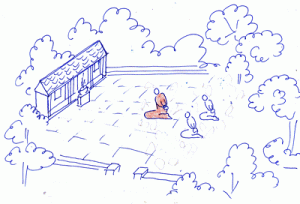
Figure 1
The truth is now obvious: the Pure Land Sect is a Heresy. It is necessary to check the sacredness of all pagodas belonging to the Pure Land Sect. The arrest of the leader and all deputies means the Heresy Pure Land Sect was completely eradicated on Earth, making 24 July 2020 a monumental feat achieved by Troi and the Buddhas. Following this, an action plan is required to cleanse all Pure Land Sect pagodas.
In Vietnam, there are more than 50 Pure Land Sect pagodas, most of which were built before or during the period when the South Vietnamese government was still in Saigon. After inspecting two pagodas—one in District 6 and one in District 1—it was found that although there are High Top Buddha statues on the main altars, only the leader of the Pure Land Sect was worshipped, rather than the High Top Buddhas. There were no cellars for detaining the Astrals of Buddhist followers. Generations of abbots at these pagodas were likely unaware that they were worshipping the Heresy Pure Land Sect; believing they were paying homage to the High Top Buddhas, they continued to worship single-mindedly. The pagodas also engage in charitable activities, such as helping the poor and offering free medical healing. They regularly organise ceremonies for Buddhist disciples to sit in quiet contemplation and look toward the Buddha’s realm, as dictated by the Pure Land motto. However, all these ceremonies failed because the High Top Buddhas were not actually worshipped at the pagodas. Since the monks were unaware of this, they are not at fault. Likewise, the pagoda protectors—such as Duc Ong and the Colossuses (Dharma protectors)—were unaware and did not follow the Pure Land Sect, so they bear no fault either. The High Top Buddhas explained the reality of the Pure Land Sect to them, and they have been permitted to remain and carry out their duties at the pagodas.
The Buddha altars of these two pagodas have been cleansed of the bad Khi of the Pure Land Sect, their incense bowls purified, and the High Top Buddhas invited to accept the statues and incense bowls. The High Top Buddhas also issued a notice to all Astral and Rough men as follows: From now on, these pagodas are officially designated for the worship of the High Top Buddhas (the pagoda in District 6 is dedicated to the worship of High Top Buddha OLMO, and the pagoda in District 1 is dedicated to High Top Buddha Shakyamuni). Everyone visiting these pagodas from this moment forward is truly paying homage to the High Top Buddhas.
The abbots of these pagodas will no longer organise ceremonies to recite Amitabha’s name, but will instead return the pagodas to normal operations, like any ordinary Buddhist pagoda. All documents regarding the Pure Land Sect transmitted through Northern Asian Buddhism over a thousand years ago must be destroyed and no longer used.
3. Zen Sect
Meditation is the art of sitting with a quiet mind, eliminating misconceptions, and maintaining mindfulness toward the Buddha. Meditation in Buddhism dates back to the era of Theravada Buddhism and continues to this day.
Zen Buddhism is a Buddhist sect that separated from Mahayana Buddhism, initiated by Indian Buddhist ancestors in the second and third centuries, before spreading to China, Vietnam, Korea, Japan, and other regions.
The original essence of Zen Buddhism was to direct practitioners to meditate in mindfulness, guiding the mind to eliminate Greed, Hatred, and Delusion while striving toward Truth, Goodness, and Forbearance. It was High Top Buddha Shakyamuni who used this method during his six years of ascetic cultivation in a mountain cave in South India, albeit without success. He subsequently altered his practice, abandoning extreme asceticism, and meditated for 49 days beneath the Bodhi tree at Bodh Gaya, where he attained the Dao and enlightenment. Later, He developed the theory of cultivation according to the Harmonised Method (or Middle Way). He realized that neither ascetic practices nor indulgence in the pleasures and glory of worldly life could lead to the attainment of the Dao. High Top Buddha Shakyamuni’s Harmonised Theory sparked widespread debate at the time, leading to the formation of several sects that branched off from orthodox Buddhism, such as Esoteric Buddhism, Pure Land Buddhism, and Zen Buddhism.
Zen Buddhism was originally an effort of good faith that merely separated into a distinct sect to compete for influence with original Buddhism. Gradually, however, it turned to oppose the Orthodox Buddhism led by High Top Buddha Shakyamuni, evolving into a Heresy.
Heresy Zen Buddhism advocates meditating to achieve deep concentration (Samadhi) while constantly contemplating Shakyamuni Buddha, hoping to be brought by Him to the Saha realm (where He resides). The sole difference between the Pure Land and Zen sects is that one seeks the Western Pure Land of Amitabha, whereas the other seeks the Saha realm of Shakyamuni. Like the Pure Land sect, the Zen sect made the mistake of failing to cultivate the mind and practice Cong, rendering true success in cultivation impossible. This approach is a form of deception that encourages superstitious worship of the High Top Buddha to entice cultivators into believing in and worshipping Zen Buddhism. Practitioners rely excessively on the advice and teachings of former Zen masters, believing that merely understanding these teachings can bring about enlightenment—a view that contradicts the true teachings of High Top Buddha Shakyamuni. They do not entirely discard Buddhist scriptures, yet they place improper reliance upon them.
The Event of 25 July 2020: Similar to the event involving Pure Land Buddhism mentioned above, Buddhist cultivators sitting in meditation in Hanoi were attacked with bad Khi by Heresy Zen Buddhism. Troi Supreme Power and the High Top Buddhas appeared to rescue them. Following a pursuit, two pagodas in North Asia were discovered to be the strongholds of this Heresy. One leader of High Buddha level 8 (wearing a brown robe) and two deputy leaders of this Heresy were arrested and brought to the Troi Buddha Temple in Hanoi for trial (Figure 2); more than 1,600 Astrals of Buddhist cultivators imprisoned in two underground cellars were liberated. Although High Top Buddha statues were present inside the pagodas, they were not used to worship the Buddha; only the leader and deputies of the Zen sect were worshipped there. Troi and Buddha cleansed the bad Khi from the Buddha altars, purified the incense bowls, and invited the High Top Buddhas to accept the statues and incense bowls. A Notice of Eradicating Heresy was subsequently posted, declaring that from that moment on, the pagodas are officially designated for the worship of the High Top Buddhas.
Think of how many years people wasted visiting these pagodas only to unknowingly worship a Heresy. This event represents another great victory for Troi and Buddha in eradicating Heresy Zen Buddhism worldwide. On Earth, only these two pagodas served as strongholds for this Heresy, with no other facilities existing. In Vietnam, there are no pagodas worshipping Heresy Zen Buddhism.
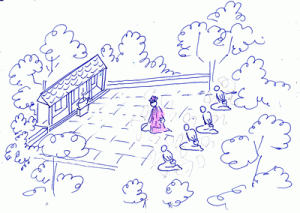
Figure 2
Therefore, readers need to understand: meditation takes place in every pagoda. The key is to meditate in mindfulness (rather than in delusion), guiding the mind to eliminate Greed, Hatred, and Delusion while striving toward Truth, Goodness, and Forbearance, rather than desiring any High Top Buddha. Desiring will never bring success in cultivation. All Buddhist pagodas should guide Buddhist disciples to do the same. If they have a Superior to transmit Cong, their mind should be focused on absorbing the energy being transmitted into the body. See also: link
Remember:
Esoteric Buddhism has been destroyed.
The Pure Land Buddhism has been destroyed.
Zen Buddhism has been destroyed.
There is no Esoteric Buddhism, Pure Land Buddhism and Zen Buddhism anymore.
Prof.Dich- High Top Buddha Van Van Quang – Hugo Hama
Our Visitors: 4,296 , 12